Why a V4 pipeline in progress matters for hotel based media coworking
Media coworking in hotels has moved from experiment to structured asset strategy. A V4 pipeline in progress signals that owners, operators, and brands are now industrializing how these hybrid spaces are conceived, financed, and operated. For hotel exploitants and asset directors, this shift turns scattered pilots into a repeatable framework that can be benchmarked, scaled, and compared across portfolios.
In practical terms, a mature V4 pipeline means your hotel coworking and media spaces are no longer isolated projects but part of a sequenced roadmap that links feasibility, design, commercialisation, and performance monitoring. Each phase is defined by clear investment thresholds, risk profiles, and partnership models, which allows asset managers to align capex decisions with long term positioning of the property. This phased approach also reassures HR leaders and corporate real estate teams that the spaces they recommend to employees will remain stable, professional, and supported by robust service level agreements.
For coworking operators, a V4 rollout clarifies how many hotel based locations can realistically be opened per year, in which cities, and under what brand architecture. It also structures the media layer, from podcast studios and content rooms to event broadcasting capabilities, so that each new site contributes to a coherent network rather than a collection of one off amenities. The result is a more predictable revenue mix for hotels, a clearer value proposition for enterprise clients, and a stronger narrative for investors evaluating hospitality coworking strategies. As one asset manager for a 15 hotel portfolio in Southern Europe put it, “once we treated media coworking as a pipeline instead of a side project, we could finally compare sites, double down on what worked, and exit what did not.”
Building the business case: from concept to board ready V4 pipeline in progress
Turning a media coworking concept into a board approved project requires a disciplined business case, and this is where a V4 pipeline in progress becomes a powerful internal tool. Asset directors and hotel exploitants need to show how repositioning underused meeting rooms or lobby areas into coworking and media spaces can lift revenue per square metre while protecting core hospitality operations. A structured pipeline forces teams to quantify addressable demand, expected occupancy, and ancillary spend from day one.
For ownership, the most convincing arguments usually combine three elements: a clear capex envelope, a realistic ramp up curve, and a partnership structure that limits operational risk. Resources such as the hotel coworking business case playbook, available through a dedicated guide on building the deck that gets ownership to say yes, help teams translate qualitative benefits into quantitative scenarios. When these scenarios are embedded into a V4 pipeline in progress, they can be replicated across multiple assets, with each iteration improving underwriting assumptions and operational standards.
A concrete example illustrates how this plays out. A 220 room urban hotel in Western Europe converted 180 square metres of low yielding meeting space into a mixed coworking and media zone with two small studios. Initial capex was kept below 450,000 euros, with a three year payback period based on a target of 65 % workstation occupancy and 30 hours of studio bookings per week. After 18 months, the space was tracking at 58 % desk occupancy, studio utilization of 24 hours weekly, and a 22 % uplift in F&B revenue linked to coworking users, which was sufficient for the board to approve two additional projects in the same V4 pipeline in progress.
Innovation leaders and HR directors also play a decisive role in this business case, since they can validate how media coworking in hotels supports hybrid work policies, talent attraction, and employer branding. By integrating their requirements early in the pipeline, from acoustic performance of content studios to privacy standards for corporate users, the final concept aligns with both financial and human capital objectives. This cross functional alignment is what turns a promising idea into a repeatable, board ready strategy rather than a one off flagship project.
Choosing the right partners for a scalable V4 pipeline in progress
Once the strategic intent is clear, the next challenge is selecting the right coworking and media partners to support a V4 pipeline in progress. Hotel owners and asset managers must decide whether to operate spaces in house, sign management agreements, or license brands, each option carrying different implications for control, risk, and brand positioning. The choice of partner will determine not only the guest experience but also the depth of media capabilities, from simple meeting rooms to fully equipped production suites.
For portfolios with international exposure, understanding which coworking space operators are best suited to hotel based media coworking strategies is critical. Detailed guidance on this topic is available in a dedicated analysis of which coworking space operators to choose in the United States for hotel based media coworking strategies, which can serve as a template for other regions. Integrating such operator selection frameworks into a V4 pipeline in progress ensures that each new site benefits from lessons learned on brand fit, pricing models, and community building.
Corporate clients and HR leaders should be involved in partner evaluation, since their teams will be the primary users of these spaces for hybrid work, training, and content creation. They can stress test proposed service levels, digital access systems, and wellness standards, ensuring that the chosen operator can support enterprise grade requirements. When this feedback loop is formalized inside the V4 pipeline in progress, it reduces the risk of misalignment between hotel ambitions and actual user expectations.
Designing media coworking spaces in hotels within a V4 pipeline in progress
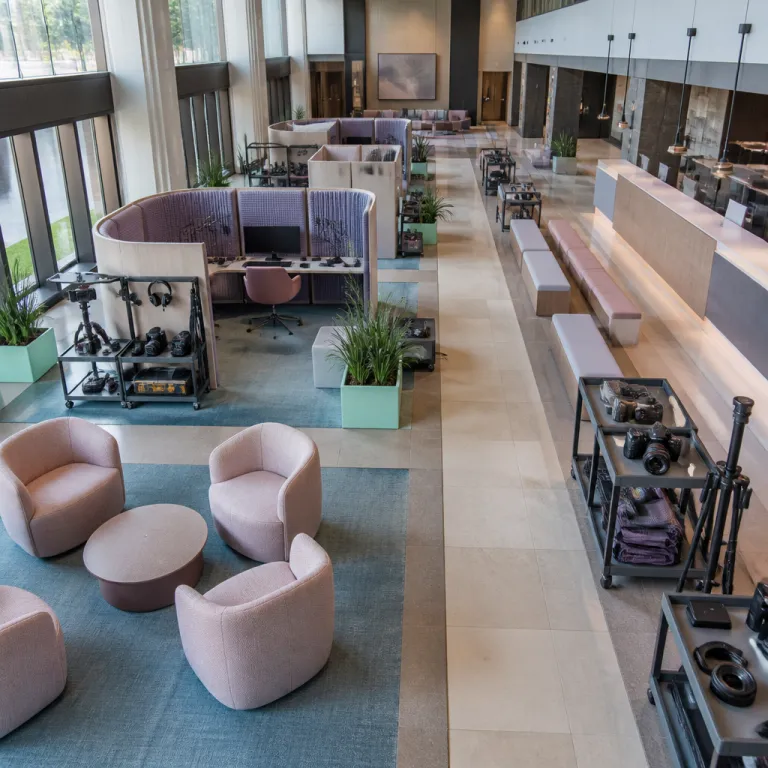
Designing media coworking spaces inside hotels requires a different mindset from traditional meeting room refurbishment, and a V4 pipeline in progress provides the structure to manage this complexity. The most successful projects treat coworking, content creation, and hospitality as a single ecosystem, where circulation, acoustics, and lighting are orchestrated to support both productivity and guest comfort. This means thinking simultaneously about day pass users, long term members, hotel guests, and event attendees.
In early pipeline phases, design teams should map how each square metre can flex between coworking, media production, and social uses across the day. For example, a lounge area near the lobby might serve as hot desk space in the morning, podcast recording in the afternoon, and informal networking in the evening, with furniture, power access, and sound treatment planned accordingly. A V4 pipeline in progress formalizes these scenarios into design guidelines that can be applied consistently across multiple hotels, while still allowing for local adaptation and brand specific storytelling.
Innovation leaders and corporate real estate teams will expect robust digital infrastructure, from high bandwidth connectivity to secure access control and room booking systems that integrate with corporate tools. They will also scrutinize wellness features such as natural light, air quality, and ergonomic furniture, since these factors directly impact employee satisfaction and productivity. Embedding these requirements into the design stage of the V4 pipeline in progress ensures that media coworking spaces are not only visually appealing but operationally resilient and aligned with enterprise standards.
Operational playbooks and media programming in a V4 pipeline in progress
Even the best designed media coworking space in a hotel will underperform without a rigorous operational playbook, and this is where a V4 pipeline in progress becomes a living framework. Standard operating procedures must cover everything from check in flows and membership management to technical support for recording studios and live streaming events. For hotel teams, this often means new roles, new training paths, and closer collaboration with coworking operators and media partners.
Programming is equally critical, because media coworking thrives on a steady rhythm of events, workshops, and content initiatives that attract both local professionals and hotel guests. A structured pipeline allows operators to test different formats, measure attendance and conversion, then scale the most effective concepts across the portfolio. Over time, this creates a recognizable signature for the brand, where each property contributes to a wider network of talks, recordings, and community gatherings that reinforce loyalty and drive repeat visits.
From an enterprise perspective, HR and learning teams can leverage these spaces for leadership offsites, training academies, and internal content production, provided that booking processes and service levels are predictable. Embedding these corporate use cases into the V4 pipeline in progress ensures that media coworking in hotels is not treated as a side business but as a core platform for client engagement and talent development. This alignment also supports more stable, contract based revenue streams that complement transient room nights and traditional meetings and events.
Measuring performance and iterating the V4 pipeline in progress
For asset managers and owners, the real value of a V4 pipeline in progress lies in its ability to generate comparable performance data across multiple hotel coworking and media sites. Traditional hospitality metrics such as RevPAR and GOPPAR are no longer sufficient; operators must track workstation occupancy, membership churn, event revenue, and media studio utilization. These indicators help clarify whether the concept is truly accretive to asset value or simply diluting focus.
Innovation leaders should also monitor qualitative indicators such as community engagement, brand perception, and employee satisfaction among both hotel staff and corporate users. Regular surveys, net promoter scores, and social media analysis can reveal whether the media coworking offer is perceived as a premium amenity or a generic workspace. When these insights are fed back into the V4 pipeline in progress, they inform adjustments to pricing, design, programming, and partnership structures for subsequent openings.
For global portfolios, benchmarking across regions is essential, and resources such as specialized hospitality coworking news and analysis, including coverage of how Mexico hospitality news is reshaping hotel coworking and media spaces on regional hotel coworking and media trends, provide valuable context. By integrating external market intelligence with internal performance dashboards, hotel groups can refine their V4 pipeline in progress to prioritize cities, brands, and formats that deliver the strongest returns. Over time, this disciplined approach transforms media coworking in hotels from a trend into a mature, data driven asset class within the broader hospitality industry.
Key figures shaping media coworking in hotels
- According to JLL’s "Global Flex Space Market" research series (for example, the 2023 update, see JLL Global Flex Space Market, 2023, p. 6), flexible workspace is expected to represent around 30 % of total office stock in major cities within the next decade, which reinforces the strategic relevance of integrating coworking into hotel assets as corporate clients diversify their workplace portfolios.
- CBRE’s "2022 Global Flexible Office Market" report (CBRE, Global Flexible Office Market, 2022, p. 4) notes that more than 80 % of large corporations now use some form of flexible workspace, indicating a strong demand base for hotel based coworking and media spaces that can support distributed teams and project work.
- Data from STR’s "Hotel Industry Performance" analyses, including regional total revenue per available room (TRevPAR) benchmarks published in 2021 and 2022 (for example, STR Global Hotel Study, 2022, Exhibit 5), show that hotels with strong ancillary revenue streams, including coworking and meetings and events, tend to outperform their competitive sets on total revenue per available room, underlining the financial potential of media coworking concepts.
- Global coworking market analyses from Cushman & Wakefield, such as the "Coworking 2022: The Flexible Office Evolves" report (Cushman & Wakefield, Coworking 2022, p. 9), highlight that secondary cities are experiencing some of the fastest growth in flexible workspace supply, which aligns with the opportunity for regional and midscale hotels to adopt a structured V4 pipeline in progress for media coworking rollouts.
FAQ about media coworking in hotels and a V4 pipeline in progress
How does a V4 pipeline in progress differ from a simple pilot project ?
A V4 pipeline in progress defines a repeatable sequence of phases, from feasibility and design to launch and optimization, across multiple hotel assets. Unlike a one off pilot, it embeds governance, KPIs, and partner frameworks that can be applied portfolio wide. This structure reduces risk and accelerates learning for owners and operators.
What are the main revenue streams for media coworking in hotels ?
Typical revenue streams include coworking memberships, day passes, meeting room bookings, and media studio rentals for podcasting or video production. Hotels can also generate income from events, sponsorships, and food and beverage linked to coworking usage. A V4 pipeline in progress helps quantify and balance these streams for each property.
How should HR and corporate real estate teams evaluate hotel based media coworking offers ?
HR and CRE leaders should assess location accessibility, digital infrastructure, privacy standards, and wellness features such as light, acoustics, and ergonomics. They also need clarity on service levels, security protocols, and integration with corporate booking tools. These criteria should be built into the evaluation stage of any V4 pipeline in progress.
Can existing meeting spaces be converted into media coworking without major capex ?
Many hotels can start by reconfiguring underused meeting rooms with modular furniture, improved acoustics, and upgraded connectivity, which limits initial capex. However, dedicated media studios and advanced hybrid event capabilities usually require more targeted investment. A V4 pipeline in progress helps prioritize which assets justify deeper transformation.
Which KPIs are most relevant to track the success of media coworking in hotels ?
Key indicators include workstation occupancy, membership growth, event and media studio utilization, and total revenue per square metre of flexible space. Guest satisfaction scores and corporate client retention are also critical to understand long term viability. Embedding these KPIs into the V4 pipeline in progress enables consistent benchmarking across the portfolio.