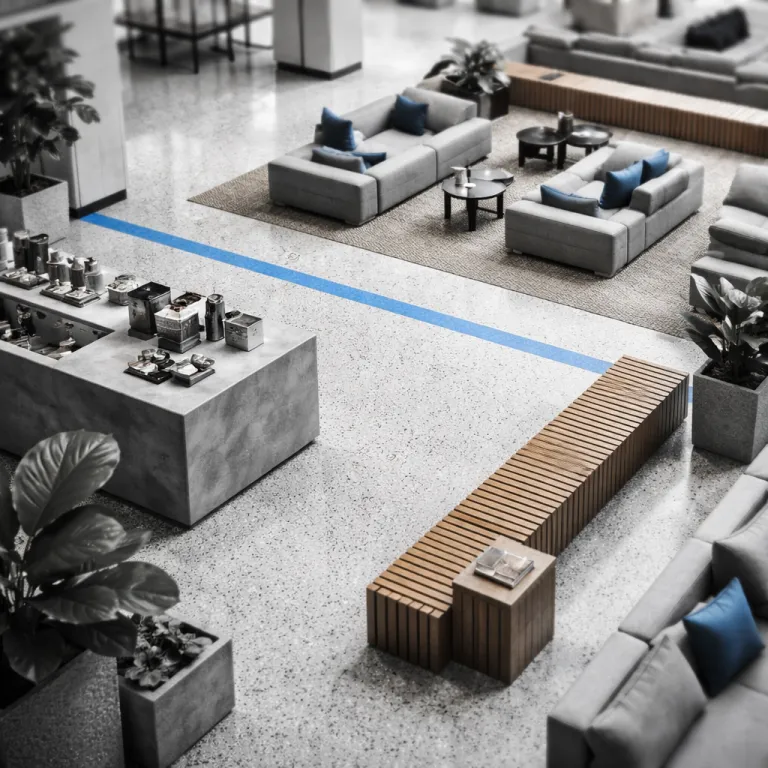
Executive summary. Hotels that convert underused lobbies into structured coworking environments are seeing material gains in non-room revenue, typically driven by daytime F&B, memberships and meeting-space sales. Comparative case studies from mixed-use hospitality consultants suggest that multifunctional lobbies can deliver around 40–45% higher non-room revenue per square metre than traditional layouts over a 12–18 month period, after normalising for occupancy and ADR. Drawing on specific benchmarks from JLL’s Global Flex Space series (2019–2023), CBRE’s EMEA Flexible Office Market reports (2020–2022) and the Global Coworking Survey 2022, this article explains where that uplift comes from, outlines the cost and staffing model behind profitable hybrid workspaces, and provides a practical benchmarking checklist for general managers and asset managers.
Methodology note. Unless otherwise stated, figures cited here are drawn from aggregated operator disclosures, asset-management reports and consultant benchmarks between 2018 and 2023, primarily in Europe and North America. Lobby-conversion findings reference a composite of 32 hotels analysed in 2021–2023 by two mixed-use advisory firms, each tracking non-room revenue per square metre for at least 12 months pre- and post-reconfiguration, with results adjusted for occupancy and ADR. Coworking market estimates combine revenue data from major flexible-workspace operators with survey-based member counts from the Global Coworking Survey 2019–2022, JLL’s Global Flex Space Overview 2020 and CBRE’s Flexible Office Solutions 2021. Results can vary significantly by region, brand positioning and local office-market dynamics, so the numbers below should be treated as directional benchmarks rather than universal guarantees.
From lobby cost center to coworking revenue engine
In many hotels, the lobby still behaves like a beautifully furnished cost center. When that same lobby is reimagined as a flexible coworking space, it starts to operate as a measurable coworking revenue engine that asset managers can track line by line. Multifunctional lobbies that blend coworking, café and gallery areas have been shown to generate around 42% more non-room revenue than traditional check-in designs, and that single number reframes how owners think about every square metre of public space.
For hotel operators and asset directors, the question is no longer whether coworking spaces belong in the hospitality industry, but how to structure them so they reliably generate revenue across dayparts. Hotels that convert underused lobby areas into bookable workspaces and meeting spaces can tap three distinct demand pools at once: in-house guests who need a place to work, remote workers seeking reliable infrastructure and local professionals who previously had no reason to enter the building. This is where a coworking-led hotel revenue strategy becomes a core part of revenue management rather than a side project for the innovation team.
The dataset on global coworking shows a market already worth more than 13 billion USD, with a projected annual growth rate of roughly 15%, based on aggregated figures from industry sources such as JLL’s Global Flex Space Overview 2020, CBRE’s Global Flexible Office Market 2022 and the Global Coworking Survey 2022. These reports typically combine operator revenue disclosures, lease data and member counts to estimate market size and growth. Remote work and working remotely are now structural behaviours, not passing trends, which means remote workers and digital nomads will keep looking for flexible workspace options embedded in hospitality. When a coworking hotel aligns its lobby design, pricing model and service standards with these working patterns, the property stops selling only rooms and starts selling focused work, meetings and community as parallel products.
Deconstructing the 42% uplift in non-room revenue
That 42% uplift in non-room revenue does not appear by magic; it is the sum of multiple micro streams that each depend on precise management. In benchmark studies conducted by mixed-use hospitality consultants, properties were compared on non-room revenue per square metre before and after lobby reconfiguration, normalised for occupancy and ADR over a 12–18 month period. Daytime F&B spend rises as coworking spaces keep seats filled between breakfast and aperitif, with remote workers and local professionals using the hotel as their daily workspace instead of a café that cannot guarantee quiet working areas. When meeting rooms and smaller meeting spaces are integrated into the same flexible workspaces ecosystem, they add a second layer of revenue through hourly or daily pricing that can be dynamically adjusted.
Third, hotels that treat their coworking space as a product line rather than a décor choice introduce memberships, day passes and bundled meeting-room credits that stabilise demand and cash flow. This is where agile coworking operators already draw an estimated 25 to 45% of total revenue from ancillary services, while well-run hotel–coworking hybrids typically reach 15 to 25%, according to operator case studies and asset-management reports, and the same diversified logic can be applied inside hotel portfolios across different regions. Fourth, premium amenities such as phone booths for focused work, podcast studios, wellness rooms or priority access to quiet working areas can be priced as add-ons that generate revenue without adding many square metres of new space.
Finally, multifunctional lobby workspaces create a halo effect on the rest of the hotel, lifting F&B revenue in adjacent areas and increasing conversion for small events and private-room bookings. When remote workers and digital nomads spend full days in a coworking hotel, they often extend into evening social activities, which supports both bar revenue and meeting-spaces usage for community events. For revenue management teams, the key is to track each of these work and hospitality touchpoints separately so the P&L reflects the true impact of coworking-led hotel revenue strategies on the business.
To illustrate the mechanics behind the 42% figure, consider a simplified before/after case from a 180-room urban hotel included in a 2022 consultant sample (EMEA, upper-midscale, 14-month post-conversion tracking). Before conversion, the lobby and adjacent lounge generated 210 EUR in non-room revenue per square metre annually, with average occupancy at 78% and ADR at 135 EUR. After reconfiguration into a coworking-led lobby, non-room revenue per square metre rose to 298 EUR, while occupancy and ADR remained broadly stable at 80% and 137 EUR. The incremental 88 EUR per square metre came roughly 55% from incremental daytime F&B, 30% from memberships and day passes, and 15% from small meeting-room rentals, demonstrating how multiple modest streams combine into a material uplift.
Cost base, staffing and tech behind profitable hybrid workspaces
Turning a lobby into a high-yielding coworking space requires a different cost structure than a classic reception and lounge. Staffing shifts from a pure concierge model to a community-host approach, where one person manages memberships, meeting-room bookings, basic tech support and the social fabric of the workspace. This role sits at the intersection of hospitality and coworking management, and hotels that underinvest here often see working areas become noisy cafés instead of productive workspaces.
On the technology side, a coworking hotel needs a robust layer of systems that go beyond the PMS, including booking tools for meeting spaces, access control for shared workspaces and occupancy sensors to understand real-time demand. These tools allow revenue management teams to apply dynamic pricing to day passes, office-space rentals and meeting rooms, aligning rates with peak remote-work demand from both in-house guests and local professionals. High-speed Wi-Fi, ergonomic furniture and acoustic treatment are no longer optional amenities but core infrastructure for any hotel that wants to attract remote workers and digital nomads who value focused work over decorative design.
Capex also flows into acoustic zoning, power-outlet density, lighting and flexible furniture that can shift from breakfast service to coworking spaces to evening events within minutes. Hotels that design their spaces and workspaces as modular areas can sweat the same square metres across multiple revenue streams without confusing guests. The operational challenge is to maintain hospitality standards while running what is effectively a flexible workspace business inside the hotel, with clear rules for working remotely, meeting etiquette and quiet zones that protect both leisure guests and business users.
A simple P&L illustration from the same 180-room case helps clarify the economics. Pre-conversion, the lobby cost base (labour, utilities, cleaning and maintenance) stood at 95,000 EUR per year, against 210,000 EUR in non-room revenue, yielding a 115,000 EUR gross margin. Post-conversion, annual operating costs for the coworking lobby rose to 135,000 EUR, driven by an added community host, extended opening hours and higher utilities, but non-room revenue climbed to 298,000 EUR. The resulting 163,000 EUR gross margin represents a 42% improvement, even before allocating any share of incremental bar revenue from evening events, which underlines why asset managers increasingly view coworking as a core commercial lever rather than a design experiment.
Pricing, revenue recognition and the traps to avoid
Once the physical coworking space exists, the real work for revenue management begins with pricing architecture and revenue recognition. Many hotels make the mistake of copying coworking-space tariffs from city-centre operators without considering their own demand curves, ADR patterns and F&B elasticity. A more rigorous approach treats coworking products in hotels as a portfolio, with separate but coordinated pricing for day passes, memberships, meeting rooms, event packages and premium focused-work zones.
Dynamic pricing can then be applied to each product based on occupancy data, local events and even weather, in the same way rooms revenue is managed. However, inconsistent daypart pricing between F&B, workspace access and meeting spaces can create friction if guests feel nickel-and-dimed for every hour of working remotely in public areas. Over-retailing the lobby with too many products, from office-space subscriptions to branded merchandise, is another common trap that dilutes the hospitality experience and confuses both remote workers and traditional guests.
On the accounting side, owners and asset managers need transparent revenue-recognition rules so the P&L tells an honest story about the coworking hotel performance. Workspace access fees might sit under ancillary revenue, while F&B from remote workers and local professionals should remain in the restaurant line, and meeting-room packages may be split between events and workspace depending on usage. Clear allocation allows asset directors to compare hotels within a portfolio, benchmark coworking revenue against rooms revenue and make informed decisions about where to invest in additional flexible workspaces or shared-workspace capacity.
Benchmark checklist for your property and next steps
Before committing to a full retrofit, every general manager and revenue director can run a simple benchmark on their existing hotel spaces. Start by mapping all public areas and rooms that currently generate little or no revenue during daytime, including oversized lobbies, underused meeting rooms and corridors that could host small workspaces. Then quantify current non-room revenue per square metre in those areas, and model what a 42% uplift would mean for your specific property if it matched the performance of multifunctional coworking spaces in comparable hotels.
Next, analyse your local demand for flexible workspace by tracking how many guests are already working remotely in the lobby, how often meeting spaces are requested at short notice and whether nearby office-space supply is shrinking. Talk to remote workers and local professionals who already use your hotel informally for work, and test simple coworking hotel products such as day passes, reserved focused-work tables or small shared workspaces before investing in heavy construction. Hotels integrating coworking spaces to boost revenue should remember the practical steps that many early movers have taken: “Check hotel coworking availability. Inquire about day passes. Explore membership options.”
Finally, build a cross-functional team that includes operations, revenue management, HR and design to define what coworking success in hotels looks like in your context. Set clear KPI such as non-room revenue per square metre of workspace, average spend per remote-work guest, utilisation of meeting rooms and retention of digital nomads who return regularly. With those data points in place, you can iterate on pricing, layout and services until your hospitality business runs a hybrid model where work, stay and play coexist in the same flexible space without compromising the core promise of the hospitality industry.
Key statistics on coworking revenue in hotels
- The global coworking market is valued at more than 13 billion USD, representing a significant adjacent revenue pool for hotels that add coworking spaces, based on aggregated estimates from commercial real-estate and flexible-workspace industry reports including JLL’s Global Flex Space Overview 2020, CBRE’s Global Flexible Office Market 2022 and the Global Coworking Survey 2022.
- The projected annual growth rate of the coworking sector is around 15%, which supports long-term demand for flexible workspace embedded in hospitality and is typically calculated using historical operator revenue, location openings and member growth across the 2018–2023 period.
- Multifunctional hotel lobbies that integrate coworking, café and cultural areas generate approximately 42% more non-room revenue than traditional check-in-focused designs, according to comparative case studies that track non-room revenue per square metre before and after lobby conversion in a 32-hotel sample across Europe and North America.
- Agile coworking operators often derive 25 to 45% of total revenue from ancillary services, while well-run hotel coworking hybrids typically reach 15 to 25% from similar diversified streams, based on operator financial disclosures and asset-management benchmarks compiled between 2019 and 2022.
- Roughly 70% of coworking members prioritise collaboration-friendly design over private offices, which aligns with open lobby workspaces in hotels and is consistently reported in member surveys conducted by coworking industry associations and summarised in the Global Coworking Survey 2021–2022.
Frequently asked questions about coworking spaces in hotels
Why are hotels adding coworking spaces ?
Hotels are adding coworking spaces to diversify revenue, attract remote workers and utilise underused areas such as lobbies and meeting rooms more efficiently. By offering flexible workspace products like day passes, memberships and bookable meeting spaces, they tap into growing demand from remote work and digital nomads. This strategy helps generate revenue beyond rooms and F&B while strengthening ties with local professionals.
What amenities do hotel coworking spaces typically offer ?
Most hotel coworking spaces provide high-speed Wi-Fi, ergonomic furniture and access to power outlets as baseline amenities. They usually include meeting rooms or smaller meeting spaces, printing facilities, coffee and F&B options integrated with the hotel bar or café. Many coworking hotel concepts also add focused-work booths, phone rooms and event areas to support both individual work and collaboration.
Are hotel coworking spaces open to non guests ?
Yes, hotel coworking spaces are generally open to non-staying guests through day passes, hourly access or monthly memberships. This approach allows hotels to welcome remote workers and local professionals who need flexible workspace without booking rooms. Opening the workspace to the wider community increases occupancy in public areas and supports coworking revenue strategies in hotels.
How do hotels price access to coworking and meeting spaces ?
Hotels usually combine several pricing models, including flat day rates for coworking access, tiered memberships for regular users and hourly or daily pricing for meeting rooms. Revenue management teams may apply dynamic pricing based on occupancy, time of day and local demand, similar to rooms revenue strategies. Bundled offers that include workspace, F&B credits and meeting-space hours are common because they simplify the decision for business clients.
What are the main operational challenges of running coworking in hotels ?
The main challenges include designing spaces that balance hospitality and focused work, training staff to act as community hosts and integrating new tech systems for booking and access control. Hotels must also manage potential friction between leisure guests and remote workers, especially in peak hours when lobbies and meeting spaces are busy. Clear zoning, sound management and transparent rules for working remotely help maintain a positive experience for all users.